 XR Healthcare Landscape

Prologue
XR for Healthcare Landscape Map
Explore our interactive map showcasing XR healthcare organisations, research institutions, and key players across the UK and internationally.
View our interactive map
Executive Summary
Commissioned by the University of Liverpool’s Civic Health Innovation Labs (CHIL), this UK-wide landscape mapping study explores the role of extended reality (XR) in healthcare, with a dedicated focus on mental health. Building on the recommendations of the 2021 XR Health Alliance report “The Growing Value of XR in Healthcare“, this study examines the breadth of XR adoption across the NHS, universities and industry, and benchmarks the UK’s competitive standing globally.
Key Findings
Sectoral Adoption
XR is transitioning from early-stage research to more clinical adoption. Universities are leading, with over 60% reporting XR use, compared to roughly 30% of NHS Trusts. Private sector activity, driven mainly by micro-companies, is focused on therapeutic and training applications, but faces challenges scaling into healthcare systems.
Clinical Applications
The most prevalent uses of XR are workforce education and training, followed by mental health, physiotherapy and rehabilitation. Strong evidence is emerging in depression, anxiety and cognitive rehabilitation. However, conditions such as dementia, psychotic disorders, PTSD and substance misuse remain underrepresented despite promising research.
Technology Trends
Advances in standalone headsets, AI-driven personalisation, and biofeedback integration are expanding opportunities. New applications are emerging in neurodivergence, creative health and palliative care.
Market Drivers & Barriers
Targeted funding, such as the £20 million Mindset XR programme, is accelerating adoption. Yet key barriers persist, including limited procurement pathways, regulatory uncertainty, fragmented evidence generation and lack of sustainable funding models.
Global Positioning
The UK is internationally recognised for its strengths in combining creative industries with research and innovation. While adoption levels remain uneven, the trajectory indicates growing maturity and influence in the XR healthcare field.
Recommendations
Develop a National XR Strategy for Healthcare
- Establish a unified national XR strategy to reduce fragmentation in funding and adoption. Ensure alignment with NHS strategic priorities, including the 10-Year Plan and upcoming digital strategies.
- Update the NHS Dynamic Procurement System and/or G-Cloud Digital Market Place to include XR solutions.
- Build on existing standards and evaluation frameworks working closely with regulators and the NHS to provide a clear roadmap for industry, SMEs, and NHS adoption.
Deploy XR to Advance NHS Strategic Priorities
- Support the shift from hospital to community-based care by embedding XR into "Virtual Wards" and "Hospital to Home" models for rehabilitation, monitoring, and therapy.
- Use XR to enhance preventive health and wellbeing, from physical activity to mental health resilience, reducing long-term demand.
- Drive the shift from analogue to digital interventions, ensuring XR becomes a core part of modern, technology-enabled care pathways rather than an add-on or pilot initiative.
- Deploy XR for clinical accuracy (e.g., diagnostic simulations, professional training), improving patient adherence and outcomes while lowering per-patient costs.
Strengthen Evidence Generation and Trust
- Invest in rigorous clinical trials, health economic analyses, and real-world studies to demonstrate not only clinical efficacy but also cost-effectiveness, safety, and patient experience.
- Encourage companies to publish evidence of cost-saving and productivity benefits for NHS providers to strengthen the business case for XR adoption.
- Develop a platform to accelerate compliance, evidence generation, and commercialisation by:
- Offering tools for instant gap analysis against regulatory and compliance standards, showing innovators what is missing and how to address it.
- Supporting teams to create documentation and evidence tailored to relevant standards, reducing reliance on expensive consultants or academic staff.
- Automating the design, execution, and reporting of randomised controlled trials in line with HRA guidelines, producing regulator-ready evidence more efficiently and at lower cost.
Expand XR Infrastructure and Ecosystems
- Develop XR Labs and NHS XR Centres of Excellence concept, drawing on successful academic and healthcare models to foster co-design, evaluation, and implementation across sectors.
- Support innovation in underrepresented clinical areas (beyond anxiety and depression) and in mental health resilience, chronic condition self-management, and preventive care.
- Encourage Public - Private collaboration across industry, academia, and the NHS to accelerate deployment and scaling.
Improve Funding and Scaling Pathways
- Introduce phased or iterative funding models that support long-term sustainability.
- Ensure funding and reimbursement pathways are standardised NHS regional bodies to streamline adoption.
- Continue investment for XR solution providers to support their navigation of the complex challenges presented when scaling in the NHS.
Policy Integration, Regulation, and Scaling
- XR adoption should be supported by clear policy frameworks, regulation and governance.
- Ensure XR adoption is supported by robust governance: data protection, clinical safety, and evidence standards.
- Align deployment with Integrated Care Boards (ICBs) and local services to address population health needs and reduce inequalities.
- Embed XR within NHS operational planning (e.g., 2025/26 priorities) to reduce avoidable admissions, strengthen out-of-hospital care, and deliver productivity gains.
Foreword
It is a privilege to collaborate with the XR Health Alliance (XRHA), whose report, The Growing Value of XR in Healthcare in the United Kingdom, established an impressive foundation for progress in this sector. From the outset, XRHA have demonstrated rigour and real-world relevance, drawing together insights from different stakeholders to highlight where extended reality (XR) is already delivering impact, and where targeted action can unlock further innovative solutions in healthcare.
Building on this firm footing, we are particularly pleased to introduce the next stage of their work, a product of the University of Liverpool’s Civic HealthTech Innovation Zone, part of Liverpool City Region’s Life Sciences Innovation Zone Programme, which speaks to our determination to help tackle the health challenges our communities face and our remit to support the development of innovative solutions working with clinicians and industry partners: the UK XR Health Market Assessment and Deep Dive.
This work aligns with the City Region’s growing reputation as a trailblazer in data-driven and tech-enabled healthcare as well as it being a hub for the digital and creative sectors, where collaboration involving academics, the public sector, industry and communities is shaping more inclusive, responsive and future-oriented solutions.
What distinguishes XRHA’s contribution is their commitment to moving beyond speculation towards substance: mapping genuine adoption, identifying barriers and opportunities, and translating evidence into practical, actionable recommendations that decision-makers can confidently apply. Their passion and knowledge and expertise in the field of XR use in healthcare ensures that this is not simply an analysis of the XR market, but a blueprint for shaping and growing it.
This report reads-across to other work involving NHS colleagues and XR industry representatives to better understand local needs, capabilities and ambitions in relation to the projected deepening of challenges associated with mental health in the years ahead.
At the University of Liverpool, we are proud to partner with XRHA on this journey and look forward to working together as we realise the potential of XR in healthcare for our communities and beyond.
Introduction

About the University of Liverpool
Founded in 1881 as the original ‘red brick’, the University of Liverpool is one of the UK’s leading research-intensive higher education institutions with an annual turnover of £708.3 million, including an annual research income of £163.1 million.
Now ranked in the top 150 universities worldwide (QS World Rankings 2026), the University is a member of the prestigious Russell Group of the UK’s leading research universities and has a global reach and influence that reflects its academic heritage as one of the country’s largest civic institutions.
Further information about the Faculty of Health and Life Sciences
Further information about CHIL
Further information about M-RIC
About the Project

The University of Liverpool’s Civic Health Innovation Labs (CHIL), as part of the Liverpool City Region’s Health and Life Science Innovation Zone, has commissioned a UK-wide landscape mapping study to better understand the current state of extended reality (XR) in healthcare.
This research was informed by the original recommendations of The 2021 Growing Value of XR in Healthcare in the United Kingdom report, led by the XR Health Alliance [1]. In particular, it responds to the first recommendation titled Landscape Mapping of UK XR in the Healthcare Sector, which called for a comprehensive mapping and analysis of the businesses, healthcare organisations and universities working with XR in healthcare to better understand the UK’s capacity and capabilities, market size and scale, potential value and future growth.
Building on this recommendation, the present research project is being led by the XR Health Alliance in collaboration with the University of Nottingham’s NIHR MindTech Research Centre.
This report aims to identify and showcase the breadth of XR-related research, development and deployment across physical and mental health applications in the UK. It will serve as a valuable tool to help shape future grant programmes and support sector-wide growth and innovation.
Through this project, CHIL is working with Mersey Care NHS Foundation Trust to build on and deepen the understanding of XR in the field through the Civic HealthTech Innovation Zone programme it anchors. The CHI-Zone is part of the Liverpool City Region Life Sciences Innovation Zone Programme, part of the Government’s national Investment Zone Programme, positioning the city region as a powerhouse for health and life sciences innovation.
Definitions
This report will focus mainly on the applications of VR in healthcare, with reference to the use of AR and MR in training and education.
Extended Reality (XR) is an umbrella term encapsulating AR, VR, MR and everything in between.
Virtual Reality (VR) immerses users in a fully digital environment through a headset or surrounding display. This environment can be computer-generated or filmed in 360-degree video.
Augmented Reality (AR) presents digital information, objects, or media in the real world through a mobile device or headset. These elements can appear as a flat graphical overlay or can behave as a seemingly real ‘3D’ object.
Mixed Reality (MR) is the latter form of AR described above where physical and digital objects co-exist – in other words, the digital objects appear anchored to the real-world environment.
Virtual Worlds: Persistent immersive environments based on technologies including 3D and extended reality which make it possible to blend physical and digital worlds in real-time for a variety of purposes such as designing, making simulations, collaborating, learning, socialising, carrying out transactions or providing entertainment.
Immersive (or XR) technology solutions are being delivered in a variety of ways. Augmented reality experiences are usually accessed through a mobile phone or headset, displaying an overlay of digital objects in the user’s environment. Virtual reality is used to immerse users in a completely digital environment, usually through a headset.
Immersive technologies cover a wide spectrum and can also include adjacent technologies such as haptics which assist in immersing the user in a virtual world through an enhanced sense of touch. Often taking the form of a pair of gloves or an articulated arm, haptic technology enables users to not only see and hear their environment but feel it through vibration and changes in temperature.
A range of Head Mounted Display (HMDs) and devices are available on the market to deliver immersive experiences.
Estimates suggest that in 2020, sales of XR headsets will reach around 5.5 million units. Forecasts project massive growth in both AR and VR headset sales in the coming years, with both technologies combined expected to sell over 26 million units per year by 2023. (Statista March 21).
The picture that emerges is of rapidly increasing access to, and use of, devices and interfaces that support the delivery of XR healthcare solutions and experiences at an unprecedented scale.
The range of HMDs, devices and software available on the market is set to increase with the expected launch of Apple’s AR glasses, Microsoft Mesh -which enables presence and shared experiences through MR across devices - to Facebook’s neural signal wrist trackers.
Development Platforms and Software
Immersive experiences can be developed on several platforms. The most popular are Unity and Unreal, which account for the vast majority of XR applications. Some startups are also offering their own platforms, which simplify the creation and distribution of XR experiences.
WebXR technology is making access to XR experiences even easier for users. Instead of creating an application that needs to be downloaded from a store and installed locally on a user’s device, it can simply be loaded from a web browser on the user’s mobile phone or headset. This distribution model is becoming increasingly popular as it makes XR experiences quicker and simpler to access. However, it can pose a challenge where the internet is not available, not reliable, or restricted as may be the case with some hospitals. Mozilla Hubs allows users in VR or on desktop computers to access a shared virtual world together and is a good example of WebXR technology in action.
XR - An introduction and the stats
The field of immersive technology has rapidly been developing over the last 9 years. Following the launch of the Oculus DK1, and the subsequent advancement of technologies across multiple platforms and hardware, virtual, augmented and mixed reality has been applied across a number of industries from entertainment and gaming to training, education and increasingly in healthcare.
Whilst the definition of immersive becomes increasingly broad, including the proliferation of immersive theatre and cinema, this report will focus on the adoption of technology enhanced experiences through VR, AR and MR.
The ability to enable opportunities to simulate environments, with embodied interactions that can range from playful to practical rehabilitation skills make this technology unique. The heightened sense of realisation can help experiences feel more visceral, which can be useful for recreating reality and an enhanced sense of immersion. Equally the opportunity to abstract data and make experiences that would be impossible in reality from data visualisation to fantasy scenarios can be equally powerful.
XR Applications in Healthcare
Extended Reality (XR) serves as a comprehensive term encompassing Augmented Reality (AR), Virtual Reality (VR), and Mixed Reality (MR), with each offering distinct yet complementary immersive experiences. In the healthcare sector, these technologies are not merely supplementary tools but are becoming fundamental drivers of innovation, efficiency, and accessibility in modern medicine. Their application extends across the entire spectrum of healthcare, from foundational education to advanced surgical procedures, patient rehabilitation and mental health interventions.
Defining XR in healthcare involves understanding how these technologies integrate digital content with the physical environment to create interactive and simulated experiences. Augmented Reality overlays digital information onto the real world, enhancing perception without fully obscuring the user’s surroundings. Virtual Reality, conversely, immerses users entirely in a simulated environment, often for training or therapeutic purposes, by blocking out the physical world. Mixed Reality represents a more advanced blend, allowing real and virtual worlds to coexist and interact in real-time. This integration is designed to enhance clinical precision, accelerate learning for healthcare professionals, and improve patient outcomes through highly interactive experiences [2]. By leveraging cutting-edge visualisations and interactive simulations, XR provides healthcare professionals with valuable tools for diagnostics, treatment planning, and patient engagement [3].
The transformative potential of XR in healthcare is profound. It is revolutionising medical education, patient engagement and treatment methodologies by bridging the critical gap between theoretical knowledge and real-world medical scenarios [4]. This enables medical practitioners to gain practical expertise and refine their skills in safe, controlled environments, minimising risks associated with early-stage learning on actual patients [3]. The application of XR extends across various medical fields, including surgical preparation, minimally invasive surgery, pain management, rehabilitation and mental health therapies [1]. The technology’s ability to replicate complex medical environments and provide enhanced therapy sessions creates new avenues for improving patient care and rehabilitation, particularly in remote or underserved regions where access to specialised care may be limited [5, 6].
Spotlight on Mental Health and XR
The UK mental health crisis has intensified significantly. Prevalence rates of MH conditions are increasing (see Figure 1) and have been since the Covid-19 pandemic with more people seeking treatment. In 2024, the current estimate is that over 20% of adults will experience a common mental health condition in the UK, leading to significant demand for services and treatment.
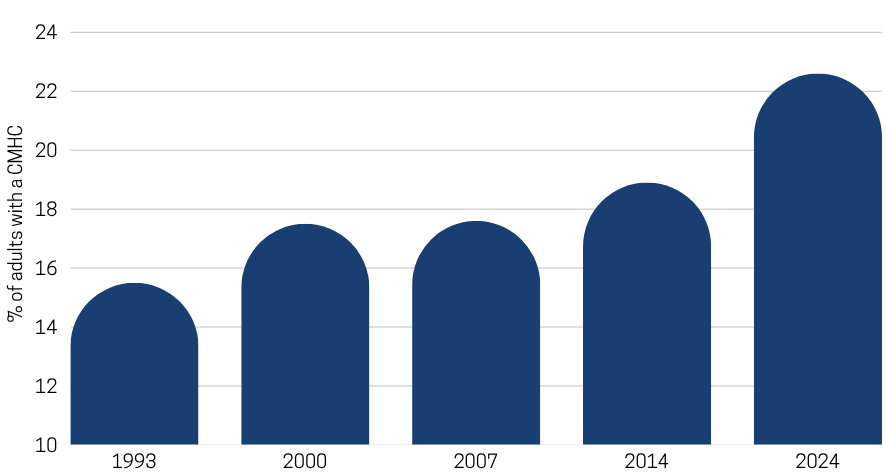
The cost of poor mental health is calculated at £300 billion a year in England, with 1 in 4 adults experiencing a mental health problem each year. More than 1 in 7 UK adults (15.5%) say their mental health is currently either bad or the worst it’s ever been, with women more likely than men to report experiencing common mental health problems (20.7% vs 13.2%). A 2023 survey found that 20% of children aged 8 to 16 had a probable mental disorder, up from 12% in 2017. PTSD prevalence has also increased from 4.4% in 2014 to 5.7% in 2023/4 with mental health problems also being strongly linked to patient physical health [7]. The healthcare system is struggling to meet demand, with mental health services in England receiving a record 5.2 million referrals during 2024 (up 37.9% from 2019) and latest estimates putting the mental health waiting list at 1 million people [7].
Mental health services, already under pressure and underfunded, are looking to digital technologies to improve access and provide high quality mental health support and treatment [8] . As highlighted in the previous section, XR technologies provide an area of significant potential as they offer additional functionality that is not available through other technologies such as smartphones. Most apparent is its effectiveness for virtually simulating scenarios or objects for use in exposure therapy, allowing people to safely confront and tackle their fears, but it can also enable so much more. For example, when combined with machine learning or other artificial intelligence (AI) it can use data from sensors (like EEGs) to adapt to individuals; it can be personalised and offer a platform of different interventions; it can be more engaging and enjoyable for repetitive or onerous therapeutic tasks; and it can potentially be delivered remotely and support access to more immersive therapeutics from the comfort of one’s home.
XR technologies are increasingly focused on addressing these challenges through immersive therapeutic interventions. For example, in 2025 the NHS commissioned Tend to supply XR therapy support solutions in its flagship Talking Therapies Services [9] and the first XR mental health company (XR Therapeutics) was accepted onto the NHS National Innovation Accelerator (NIA) Programme [10]. This adoption of XR technology is promising, but this report will provide comprehensive mapping of all such implementations across the UK to understand the full potential of these technologies.
Technology Advancement and Adoption
Although immersive technologies such as XR (extended reality) have existed for over three decades, the commercial release of consumer headsets like the Oculus Rift, HTC Vive, and PlayStation VR in 2016 marked a turning point in the mainstream adoption of immersive media. This surge was driven by media hype and significant private sector investment, which catalysed growth innovation across both the creative and subsequently into healthcare sectors. Pioneers in the field began to experiment with new forms of interaction, exploring novel modes of locomotion, body tracking, haptics and biofeedback integration, laying the groundwork for what would become a rapidly evolving interdisciplinary field.
In 2018, Immerse UK, in partnership with the Institute of Engineering and Technology and curated by Immerse UK Healthcare Lead Sarah Ticho, hosted the UK’s first XR and healthcare conference. This milestone event showcased early applications of immersive technologies in medical training, therapeutic interventions, psychedelic research and pain management—signalling the formalisation of the sector. The series continued in 2019 and led to the launch of The Promise of Immersive Healthcare report in 2020 [20].
The COVID-19 pandemic further accelerated XR adoption. While many immersive healthcare innovations were already in development, the urgent need for scalable, remote and digital solutions drove faster deployment and normalised their use across healthcare settings. During this time, The Growing Value of XR in Healthcare in the United Kingdom report was launched, building on prior recommendations to engage government stakeholders [1]. The report contributed to one of the most significant recent developments in the UK: the £20 million UKRI Mindset XR Programme . This public investment injected renewed momentum into XR and healthcare, supporting a wave of experimentation and clinical implementation. During this time NHS Trusts such as South London and Maudsley, Torbay and Devon, Sheffield Teaching Hospital , Alder Hey Children’s Hospital, Hull University Teaching Hospital, and Leeds Teaching Hospital have emerged as national leaders, trialling and deploying immersive technologies for mental health, rehabilitation, pain management, and patient education, both in clinics and at home.
Globally, a number of networks, conferences and publications have been established. This includes VR4Rehab (Netherlands/Europe), the Games for Health Journal, Frontiers in Virtual Reality, and conferences such as the Virtual Medicine Conference (Cedars Sinai, Los Angeles) and Games for Change (New York). Research labs such as the Games for Emotional and Mental Health Lab (Radboud University), Yale XR Paediatrics, and Stanford University’s Psychiatry in Immersive Technology Consortium (SPIT-C) continue to research and deliver products into the world, supporting cross sectoral collaboration and adoption. These growing organisations demonstrate the global enthusiasm and commitment to the XR and healthcare space, with increasing cooperation between groups.
Since 2016, substantial progress has also been made in hardware and software. The development of lightweight, standalone devices such as the Meta Quest, HTC Vive, Pico and Playstation VR, alongside advancements in real-time rendering, AI integration, haptics, and biofeedback tools, has lowered barriers to adoption and enabled increasingly sophisticated applications. At the same time, institutional infrastructure in the UK has matured. Initiatives such as the £56 million Creative Industries Clusters Programme (2018–2023) [21] and CoSTAR, a £75.6 million R&D network supporting innovation across digital performance and media [22], position the UK as a global leader in immersive content creation. Universities, creative industries, and research centres within these programmes continue to develop cutting-edge tools that often find downstream value in health contexts.
However, the pipeline from innovation to healthcare impact is not without friction. Despite consumer VR headset shipments declining, demand from the enterprise market remained more resilient, particularly in large-scale immersive Location-Based Entertainment (LBE), online entertainment usage, education, healthcare and military.
While 65% of UK universities report using XR technologies, only 36% of NHS Trusts and Boards currently do. This disparity points to a persistent lag in adoption, rooted in regulatory hurdles, limited infrastructure, and challenges in clinical validation. In creative and research sectors, where regulation is lighter and the risk appetite higher, XR experiences can be more easily iterated. But healthcare applications require robust frameworks for evidence generation, compliance, and integration into existing systems. Support for commercialisation, certification, and service design remains critical for ensuring XR experiences reach patients in need.
Research Methodology
To investigate the developing trends and state of the market of extended reality (XR) in healthcare, we employed three different methods of data collection.
Scope and Rationale:
This project aimed to identify and showcase the breadth of XR-related research, development, and deployment in healthcare within the UK. The findings are intended to inform a future grant programme, help guide policy, and identify emerging innovation in the sector.
To achieve this, we employed three approaches:
- Freedom of Information requests were sent to all healthcare providers and academic institutions across the United Kingdom. These requests captured both the extent of XR adoption and the types of innovations being developed, addressing all healthcare-related applications.
- A targeted industry survey, delivered via a chatbot, was directed towards companies innovating in XR for mental healthcare. This provided an industry perspective that complemented the insights from the public-sector consultation.
- Finally, desk research was conducted to further develop case studies, inform areas of the report, and identify current research and grey literature to provide context and extend the findings.
Ethical approval for the Freedom of Information request portion of this report was obtained from the University of Nottingham, Faculty of Medicine and Health Sciences Research Ethics Committee (FMHS 301-0924).
Freedom of Information Requests
Firstly, to assess the number of healthcare organisations and universities engaging in XR healthcare applications, Freedom of Information (FOI) requests were sent to all qualifying healthcare organisations and higher education institutions in the UK. The Freedom of Information Act 2000 provides the public with a right to access information held by public authorities in the UK, including the NHS and universities.
The questions were developed from a previous FOI which was sent to all NHS mental health services to collect data on the number of digital technologies procured and used with amendments made to align to the focus of this project. Questions addressed:
- The nature of the XR technologies being used, researched or developed
- Details including names and descriptions of the products
- The categories of healthcare that were targeted
- How products were adopted and distributed
- Whether organisations had a dedicated XR Lab or Centre of Excellence
These questions were provided as both a Microsoft Forms and a Word document to allow organisations different options for responses and to streamline data cleaning and analysis where possible. FOI requests were sent to the 194 Trusts of England, 14 Health Boards of Scotland, 7 Health Boards of Wales, 6 Trusts of Northern Ireland and 135 higher education institutions in the United Kingdom.
Chatbot Survey
A Chatbot facilitated survey (developed in collaboration with Careful AI) was shared publicly with a number of national and international companies. This included reaching out to the 74 companies supported via UKRI Mindset XR programme, as well as direct contacts of XRHA and outreach to national and international partners. This approach aimed to capture industry perspectives that were not reflected in the data from the FOIs.
Secondary Research
Additionally, we conducted secondary research to map the current landscape of XR interventions used in mental health, identify regulatory considerations, and review relevant statistics. We used Google Scholar and Google search to identify academic literature, grey literature, and relevant publications. Search terms included combinations of “extended reality”, “XR”, “mental health”, “virtual reality”, “AR”, “regulation”, and “evaluation”. Documents were included focused on XR in healthcare, mental health applications, and available in English. Insights from the desk research informed the scope of our report and supported the landscape mapping conducted via the FOI and surveys.